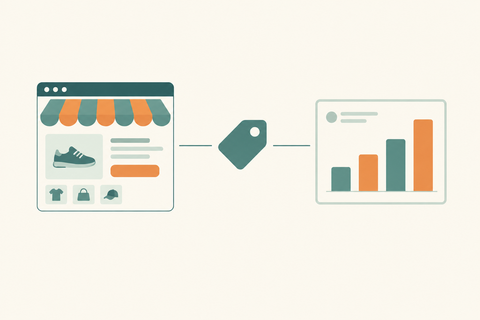
How to Optimize a Shopify Product Page for More Sales
Your Shopify product page is your best salesperson. This guide covers 7 high-impact tactics — from SEO and copywriting to trust signals and CRO — to help you convert more visitors into buyers.
Why Your Product Page Is Your Best Salesperson
Your Shopify product page is not just a listing — it's a 24/7 sales rep. Every element, from the headline to the checkout button, either builds trust or kills it. After auditing hundreds of Shopify stores and running conversion-rate optimization (CRO) experiments across categories, we've distilled the highest-impact tactics into this guide.
Whether you're selling fashion, electronics, or handmade goods, these principles apply — and the results are measurable.
1. Lead with a Benefit-Driven Product Title
Most store owners write product titles for inventory management, not for customers. A title like "BLK-500 Wireless Headphones" tells a shopper nothing. Instead, try: "BLK-500 Wireless Headphones — 40-Hour Battery, Studio-Grade Sound."
Your title should answer: What does this do for me? Include the primary keyword naturally — this also helps Shopify's built-in SEO and Google Shopping feeds pick up the right signals.
2. Write Descriptions That Sell, Not Just Describe
A product description has one job: move the shopper from interest to intent. Structure it in three layers:
- Hook (1–2 lines): Address the core problem or desire.
- Features → Benefits: Don't list specs in isolation. Pair each feature with the outcome it delivers. "Waterproof up to 30m" becomes "Take it to the pool, the rain, or the gym — it keeps up."
- Proof close: End with a trust signal — a stat, a certification, or a brief social proof line.
Aim for 150–300 words for most products. For high-consideration purchases (furniture, electronics, supplements), go deeper.
3. Use High-Quality Images and Video
Shoppers can't touch your product. Your visuals have to do the sensory work. Best practice:
- Minimum 3–5 images: hero shot, lifestyle, detail/texture, scale reference, and packaging.
- Add a 15–30 second product video or GIF showing the product in use — this alone can lift conversion by 20–30% on high-ticket items.
- Compress images for speed (use WebP format) without sacrificing quality. Page speed directly impacts both SEO rankings and bounce rate.
4. Optimize for SEO — On the Page Itself
At Thriftizer Nest, our SEO services consistently show that on-page product SEO is one of the most underutilized levers for Shopify stores. Here's what to get right:
- Meta title: Include the primary keyword within the first 60 characters.
- Meta description: Write a compelling 150–160 character summary with a soft CTA.
-
URL handle: Keep it clean and keyword-rich (e.g.,
/products/wireless-headphones-40hr). - Alt text on images: Describe the image with context — "black wireless headphones on a desk" beats "image1.jpg".
- Structured data: Shopify auto-generates basic product schema, but review it. Ensure price, availability, and reviews are surfaced correctly for rich results.
5. Build Trust with Social Proof
Trust is the single biggest conversion barrier for new visitors. Layer it in:
- Star ratings and reviews displayed prominently near the Add to Cart button.
- UGC (user-generated content): Real customer photos outperform studio shots for trust.
- Press mentions or certifications if applicable — even a single credible logo adds authority.
- Review count: "4.8 stars (312 reviews)" is far more persuasive than "4.8 stars (3 reviews)."
6. Reduce Friction at the Buy Decision
Every extra click or moment of uncertainty costs you a sale. Audit these friction points:
- Variant selectors: Use swatches for color, not dropdowns. Make out-of-stock variants visually distinct.
- Shipping clarity: Show estimated delivery dates, not just "ships in 3–5 days." If you offer free shipping, make it unmissable.
- Return policy: A visible, generous return policy reduces purchase anxiety — especially for first-time buyers.
- Sticky Add to Cart: On mobile, a sticky CTA button that follows the user as they scroll can meaningfully lift conversions.
7. Leverage Upsells and Cross-Sells Strategically
A well-placed "Frequently Bought Together" or "Complete the Look" section can increase average order value (AOV) by 10–25%. Keep recommendations relevant and limit to 3–4 products — too many choices cause decision paralysis.
The Bottom Line
Optimizing a Shopify product page is not a one-time task — it's an iterative process. Start with the highest-traffic, lowest-converting pages first. Fix the fundamentals: title, description, images, trust signals, and SEO. Then test, measure, and refine.
If you want a professional audit of your product pages or need hands-on SEO support, explore our SEO services — built specifically for Shopify stores that want to grow sustainably.